
What this is: a practical guide to capturing the evidence that shows your virtual care service works.
Who it's for: service leaders, managers, and anyone who reports to a funder or accreditor.
Why evidence matters
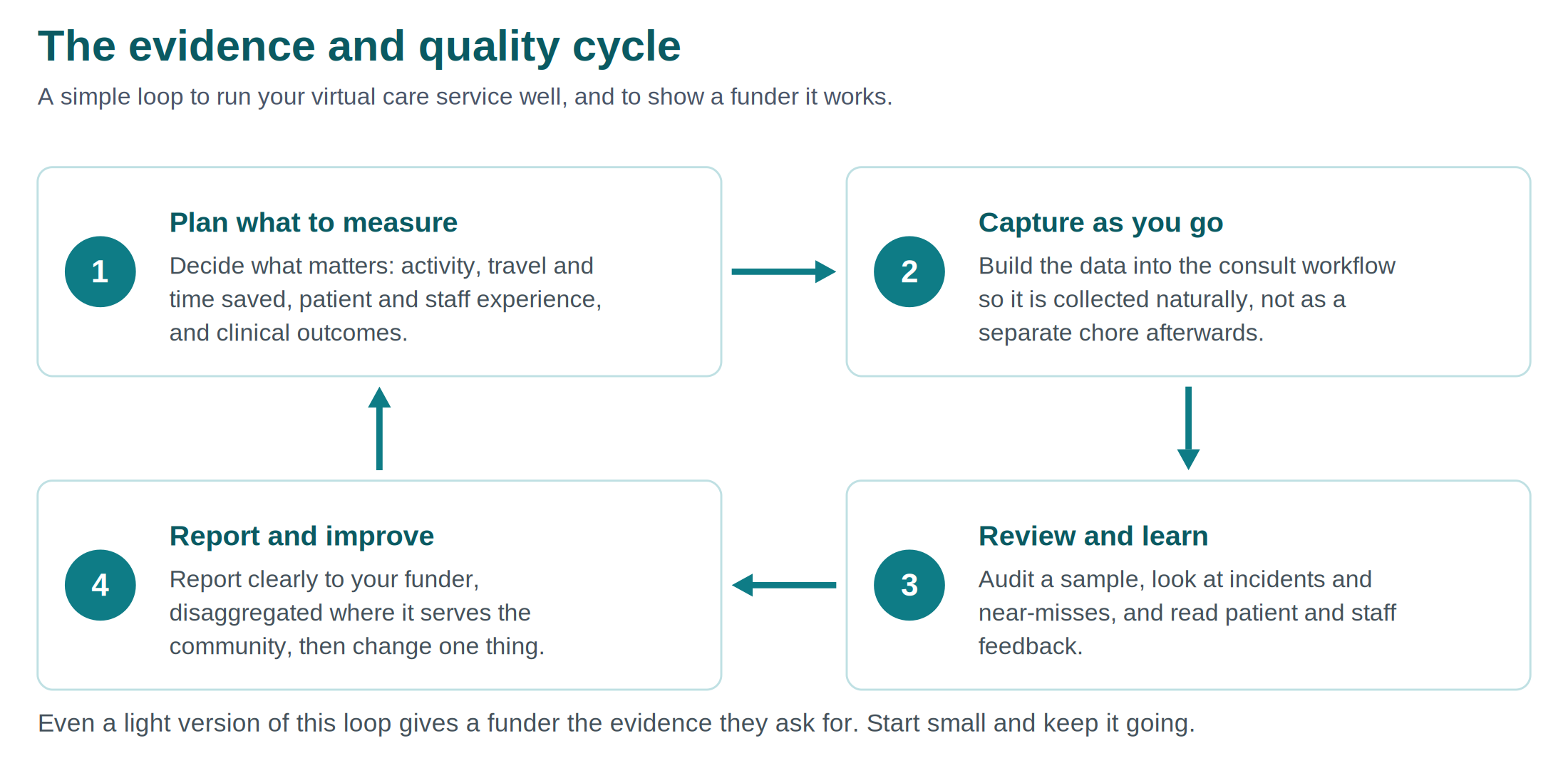
Sooner or later you will need to show that your virtual care service is safe, effective and worth the investment. A funder wants to see value. An accreditor wants to see safety and quality. And you want to know it is working so you can improve it. The good news is that a light, steady habit of capturing evidence does all three. The cycle below is the habit.
What to measure
You do not need to measure everything. Pick a handful of things that tell the story of your service.
Activity
How much virtual care you delivered: number of consults, who they were for, and what kind. This is the simplest measure and usually sits in your systems already.
Access and travel avoided
This is often the most powerful number in remote and primary care. How many trips did virtual care save, how far, and how much time and cost. A consult that saved a family a 600 kilometre round trip is a story worth telling.
Patient and community experience
Ask patients and community whether virtual care worked for them, in plain terms. A few short questions, asked consistently, are more useful than a long survey no one finishes. In community-controlled settings, make sure the questions and the results serve the community.
Staff experience
Your team's experience matters too. Are clinicians confident in the consult. Does the patient-end team feel supported. Staff who feel safe and capable deliver better care and stay longer.
Clinical outcomes
Where you can, link virtual care to outcomes that matter, such as chronic conditions better managed or problems picked up earlier. Be honest about what you can and cannot attribute to virtual care.
How to capture it without extra work
The trick is to build capture into the consult, not bolt it on afterwards. Use what your clinical system already collects. Add one or two simple fields rather than a separate spreadsheet. Where the data is about an Aboriginal or Torres Strait Islander community, disaggregate it in a way that serves the community and keep it under the community's governance, as set out in the privacy and data sovereignty article.
Reporting to your funder
A good report pairs a few clear numbers with a short, honest story. Show the activity and the travel avoided, add a line or two on patient and staff experience, and be straight about the limits, including where connectivity or workforce constrained what you could do. Funders trust a service that knows its own gaps. Lead with the numbers that matter most to this funder, and keep it short enough that they read all of it.
Need help?
- Visionflex support: visionflex.com/support | support@visionflex.com | +61 2 8914 4000 (9am to 5pm AEST)
- See also: Case studies and evidence from Australian models, Funding beyond MBS, Clinical governance and incident management, Privacy, security and data sovereignty
Visionflex acknowledges the Traditional Custodians of Country throughout Australia and pays respect to Elders past, present and emerging.