
What this is: a plain guide to your virtual care peripherals, what each one does and when to use it.
Who it's for: nurses and care staff running consultations, and anyone learning the equipment.
The peripherals are what turn a video call into a genuine clinical assessment. A remote clinician can't lay hands on the resident, so these devices become their hands: capturing wound detail, listening to a chest, recording an ECG, reading vitals in real time. You don't need every device for every consult. Use the ones that match what the clinician is assessing.
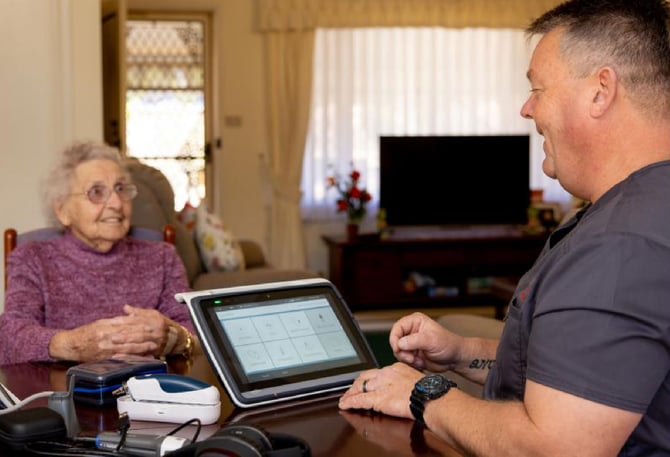
Your peripheral toolkit at a glance
The examination camera (GEIS)
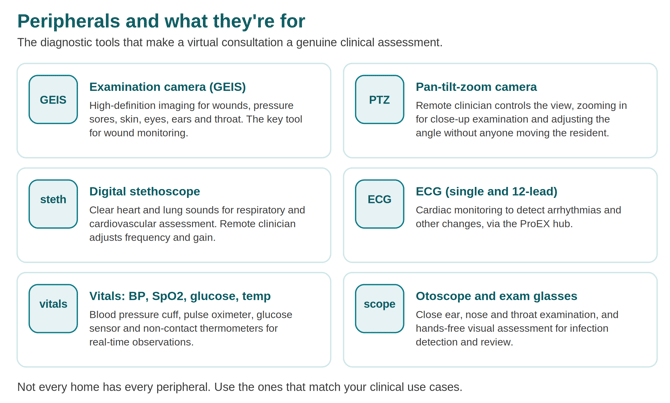
The general examination camera is the workhorse for visual assessment. It captures high-definition images of wounds, pressure sores, skin conditions, and the eyes, ears and throat. It's the key tool for wound monitoring, letting a clinician track healing accurately over time and spot early signs of infection. Hold it steady and square to the area being examined, with even lighting.
The pan-tilt-zoom (PTZ) camera
The PTZ camera gives the remote clinician control of the view. They can pan, tilt and zoom to examine the resident closely or take in the whole room, without anyone needing to reposition the resident or the equipment. It's useful for mobility assessment, observing the resident's general presentation, and close-up visual checks.
The digital stethoscope
The digital stethoscope transmits clear heart and lung sounds to the remote clinician with minimal delay. It supports respiratory and cardiovascular assessment, listening for chest congestion, breath sounds, and heart rhythm. The clinician can adjust the sound to focus on what they need to hear. Follow their directions on placement.
ECG (single and 12-lead)
Through the ProEX hub, the ECG supports cardiac monitoring, helping detect arrhythmias, ST changes and other cardiac signs. Single-lead suits quick rhythm checks; 12-lead supports fuller assessment. This brings a level of cardiac review to the bedside that would otherwise mean a transfer.
Vitals: blood pressure, oxygen, glucose, temperature
A set of devices captures real-time observations: the blood pressure cuff, pulse oximeter (oxygen saturation and pulse), blood glucose sensor, and non-contact or forehead and ear thermometers. These feed the clinician the numbers they need to assess the resident and track trends, and the contactless thermometers support infection control.
Otoscope and exam glasses
The otoscope supports close examination of the ears, nose and throat. Exam glasses give the clinician a hands-free view of what the staff member is seeing. Both help with infection detection and detailed visual review.
A few practical habits
- Pair and test each peripheral before the resident is in the room.
- Confirm the device you need is selected as active in the platform.
- Keep wireless peripherals charged, and check battery before a consult.
- Clean each device between uses, in line with infection control (see the cleaning guide).
- If a peripheral won't connect, work through the troubleshooting guide before calling support.
Need help?
- Visionflex support: visionflex.com/support | support@visionflex.com | +61 2 8914 4000 (9am to 5pm AEST)
- See also: Setting up your virtual care space, Troubleshooting: hardware and software, and Cleaning and infection control for shared devices.
Visionflex acknowledges the Traditional Custodians of Country throughout Australia and pays respect to Elders past, present and emerging.