
What this is: how virtual care fits the standards and guidelines that apply to primary care.
Who it's for: clinic managers, GPs, nurse managers, ACCHO leaders and accreditation leads.
The one rule that sits above the rest
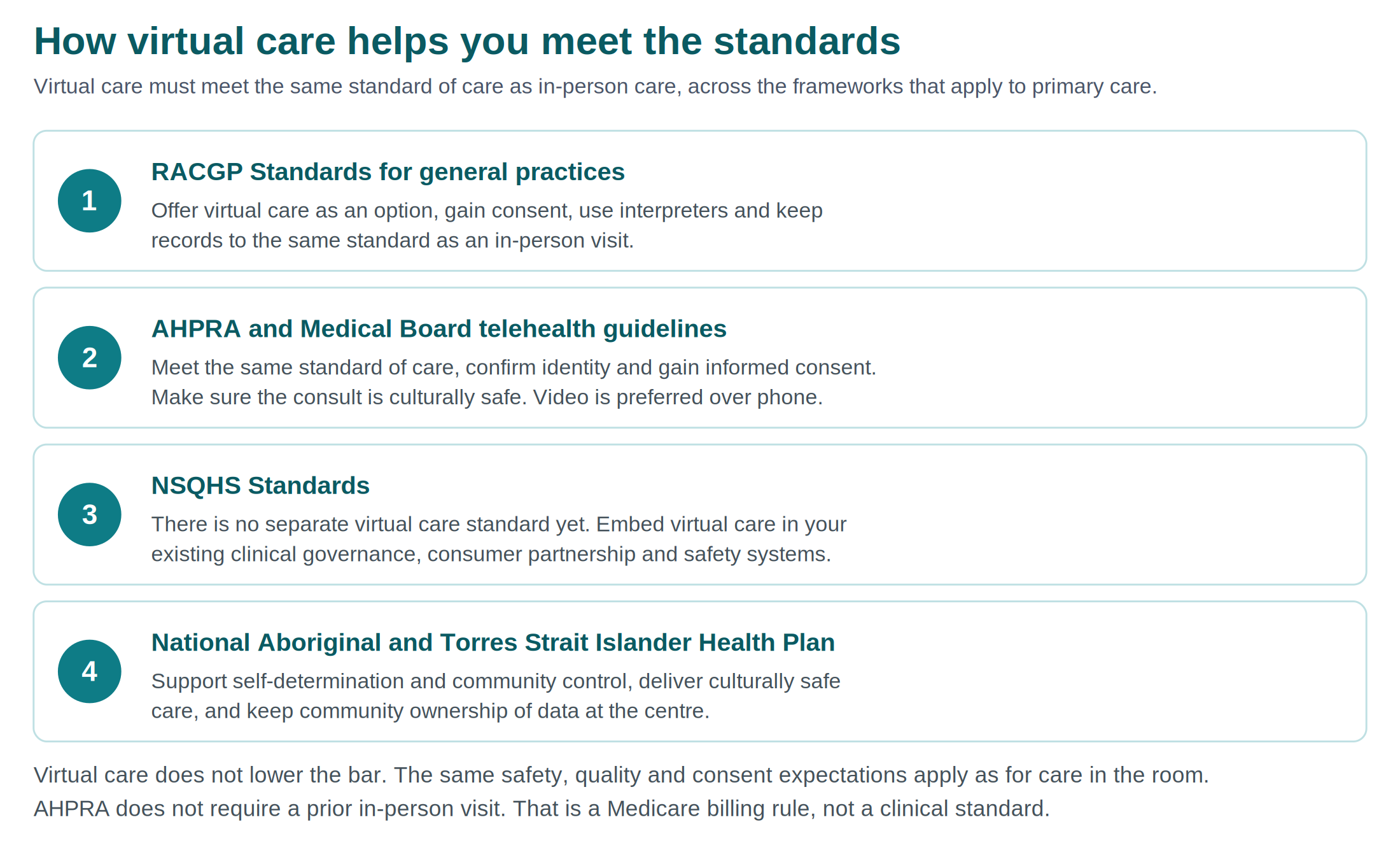
There is one rule worth holding onto before the detail. Virtual care must meet the same standard of care as care delivered in the room. It does not lower the bar. The same expectations for safety, quality, consent and cultural safety apply, whether the clinician is down the hall or down the highway.
RACGP Standards for general practices
The RACGP Standards are the benchmark for general practice accreditation. The 5th edition is the current standard. The College has developed a 6th edition, which is due for release, and once it is published there will be a transition window during which practices can be assessed against either edition. The principles that matter for virtual care carry across both.
The Standards already account for virtual care. You can offer it as an alternative to a face-to-face appointment, you connect interpreters when needed, you gain consent, and you do not record a consultation without the patient's agreement. Keep your records to the same standard as an in-person visit. If you are an Aboriginal Community Controlled Health Service, the RACGP also publishes an interpretive guide for community-controlled services that is worth reading alongside the Standards.
AHPRA and Medical Board telehealth guidelines
The AHPRA and Medical Board telehealth guidelines have applied since September 2023, and they set clear expectations for any registered health practitioner using virtual care.
A consultation must meet the same standard of care as an in-person visit. Confirm the patient's identity. Gain informed consent. Make sure the consult is culturally safe. Where you have a choice, video is preferable to phone, because it lets you see the patient. Prescribing from a questionnaire alone, without a real-time consultation, is described as not good practice. Notably, AHPRA does not require a patient to have had a prior in-person visit. That requirement exists, but it is a Medicare billing rule, not a clinical standard. See the note below.
NSQHS Standards
The National Safety and Quality Health Service (NSQHS) Standards are the accreditation benchmark for hospitals, day procedure services and many other services. The 2nd edition is current.
There is no separate virtual care standard yet. The Australian Commission on Safety and Quality in Health Care began developing dedicated virtual care standards in June 2026, to align with the next edition of the NSQHS Standards and the new National Model for Clinical Governance. Until those land, the approach is simple: build virtual care into the clinical governance, consumer partnership and safety systems you already use to meet the NSQHS Standards, rather than running it as a separate system.
The National Aboriginal and Torres Strait Islander Health Plan 2021 to 2031
The Health Plan sets the national direction for Aboriginal and Torres Strait Islander health. It calls for self-determination, genuine partnership, priority for the community-controlled sector, culturally safe mainstream services, and community ownership and control of data.
Virtual care supports these aims when it is offered by choice, delivered in a culturally safe way, and designed with the community rather than for it. It works against them when it is imposed, or when data leaves community control. Use the Health Plan as a test: does this way of delivering virtual care strengthen community control, or weaken it?
A note on the Medicare rule people confuse with a standard
People often treat the "prior in-person visit" requirement as a clinical standard. It is not. It is a Medicare billing rule, the eligible telehealth practitioner rule, and it decides when a virtual consultation attracts a Medicare rebate. It has important exemptions for this audience, including patients registered through MyMedicare and certain Aboriginal Medical Service consultations. The clinical standards above never require a prior in-person visit. For the billing detail, see the funding articles in this section.
Need help?
- Visionflex support: visionflex.com/support | support@visionflex.com | +61 2 8914 4000 (9am to 5pm AEST)
- See also: Clinical governance and incident management, Privacy, security and data sovereignty, Working with interpreters, Consent for virtual care: individual and community
Visionflex acknowledges the Traditional Custodians of Country throughout Australia and pays respect to Elders past, present and emerging.