
What this is: a plain-English guide to how virtual care supports your compliance obligations.
Who it's for: quality leads, clinical governance leads, and executives.
Virtual care and compliance pull in the same direction. The reforms reshaping aged care, the Aged Care Act and the Strengthened Quality Standards, ask providers to deliver care that is rights-based, person-centred, clinically safe and digitally enabled. Virtual care, used well, helps you do exactly that.
Two things to be clear about up front. Virtual care must meet the same safety, quality and governance expectations as in-person care; it isn't a lower standard. And it should enhance relationships and care, never replace the human connection at the heart of good aged care.
The framework
Three documents set the expectations virtual care helps you meet:
- The Aged Care Act 2025, which strengthens older people's rights to timely, person-centred care delivered how and where they prefer.
- The Strengthened Aged Care Quality Standards, which apply the same safety, quality and governance bar to virtual care as to in-person care.
- The ACQSC Digital Health Guidance, which supports digital tools that strengthen coordination, continuity and secure information-sharing.
How virtual care maps to the Standards
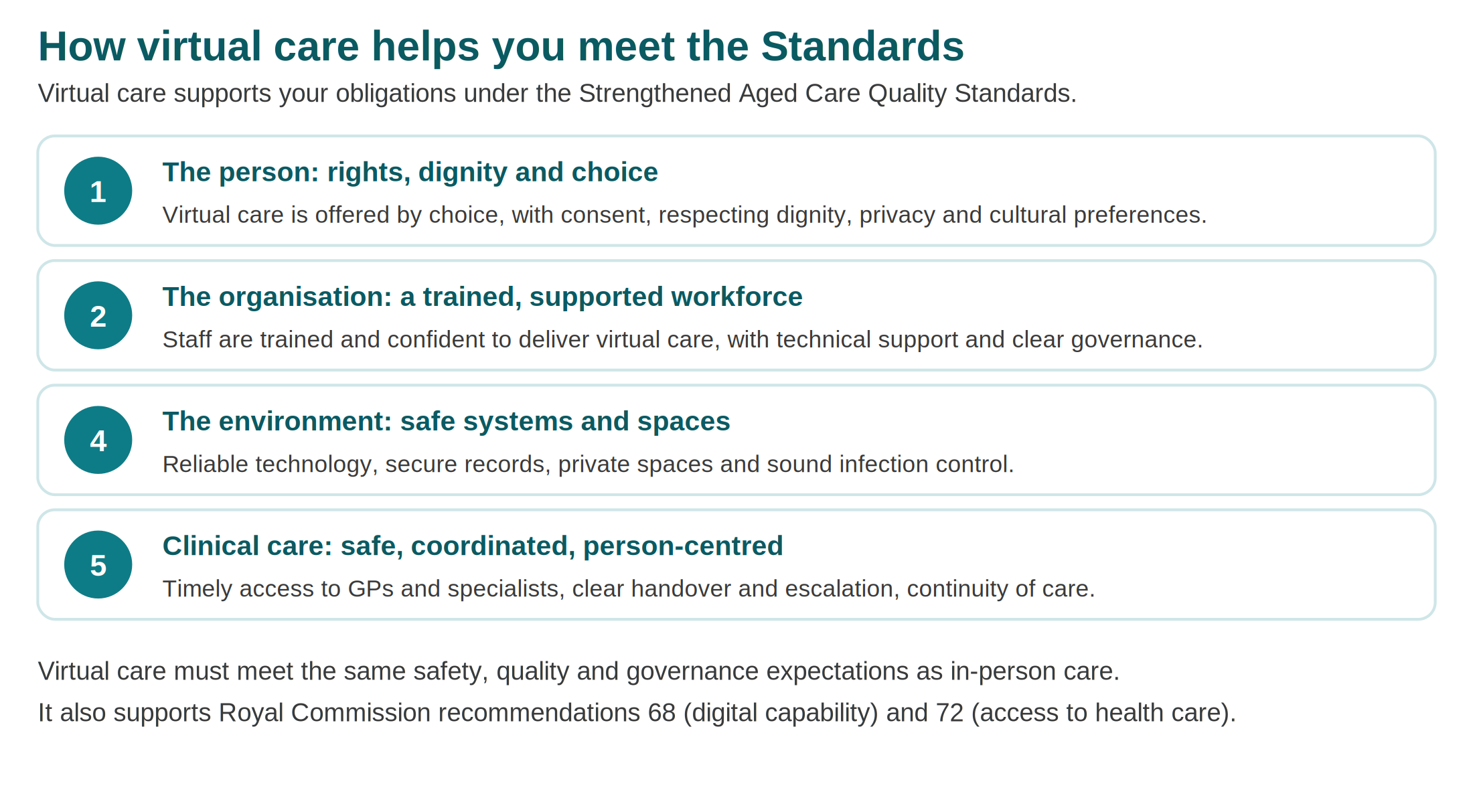
The Royal Commission set this direction
The Royal Commission into Aged Care Quality and Safety recommended that virtual care become a routine part of aged care, not a stopgap. Two recommendations matter most:
- Recommendation 68 calls for a national strategy to strengthen the digital capability of aged care services, including virtual care.
- Recommendation 72 focuses on improving access to medical and health care through better integration with general practice, specialists and allied health.
Building virtual care into everyday practice puts your home on the right side of both.
Six principles for safe virtual care
To deliver virtual care in line with the framework, work to these principles:
- Rights, choice and consent. Offer virtual care by choice, with consent covering who takes part and how information is shared.
- A safe, competent, trained workforce. Make sure staff are skilled and supported, and know when in-person assessment is needed.
- Safe systems and supportive environments. Use reliable technology, secure records and private, accessible spaces.
- Coordination and continuity. Connect virtual care to the resident's care plan, with clear referral, handover and escalation pathways.
- Quality and safety. Hold virtual care to the same clinical standards as in-person care, within your governance framework.
- Privacy and security. Protect resident information at every step, in line with the Privacy Act.
Turning principles into practice
The rest of this Resource Centre is built to help you meet these obligations in practice: a policy template and readiness audit in Policies, procedures & compliance; consent and communication templates in Communications & consent; and clinical workflows that build in handover, escalation and documentation.
Need help?
- Visionflex support: visionflex.com/support | support@visionflex.com | +61 2 8914 4000 (9am to 5pm AEST)
- See also: the Virtual care policy template and Virtual care readiness audit.
This is general guidance, not legal or compliance advice. Confirm your obligations against the current Act, Standards and guidance.
Visionflex acknowledges the Traditional Custodians of Country throughout Australia and pays respect to Elders past, present and emerging.