
What this is: a staged training pathway you can adapt for your team, with a dedicated stream for Aboriginal Health Workers and Practitioners.
Who it's for: managers planning training, and anyone learning to deliver or support virtual care.
A pathway, not a one-off
Good virtual care training is not a single session. It is a pathway that builds confidence step by step, fits each person's role, and keeps going after the first week. The stages below take someone from never having used virtual care to running consults on their own, with a dedicated stream that recognises the specific role of Aboriginal Health Workers and Practitioners.
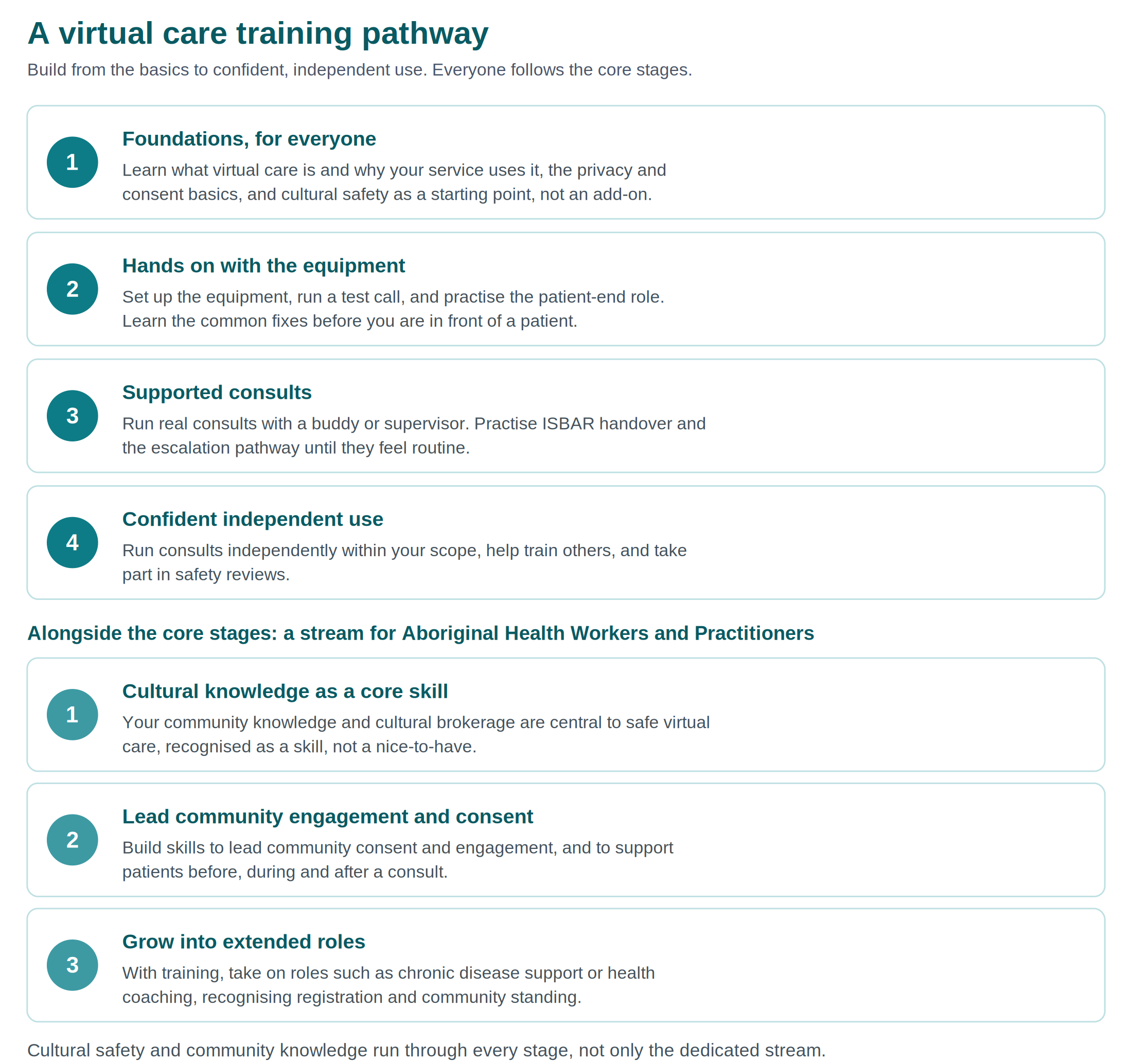
The core stages
Everyone follows these four stages, at the pace their role needs.
Stage 1: Foundations
Start with the why and the basics. What virtual care is, why your service uses it, the privacy and consent basics, and cultural safety as a starting point rather than an add-on. Keep this short and practical, so people finish it ready to pick up the equipment.
Stage 2: Hands on with the equipment
Now get practical. Set up the equipment, run a test call, and practise the patient-end role of preparing the patient and operating the tools. Learn the common fixes for a frozen screen, poor sound or a dropped connection before you are in front of a patient, not during.
Stage 3: Supported consults
Run real consults with a buddy or supervisor beside you. This is where the handover and escalation steps become second nature. Practise ISBAR handover and walk through your escalation pathway until they feel routine, so that on a hard day you are not working them out from scratch.
Stage 4: Confident independent use
Run consults independently within your scope, help train the next person, and take part in safety reviews. This stage is not the end. Skills fade without use, so build in refreshers and keep people connected to changes in the equipment and the rules.
The Aboriginal Health Worker and Practitioner stream
Alongside the core stages, this stream recognises that Aboriginal Health Workers and Aboriginal and Torres Strait Islander Health Practitioners hold skills that are central to safe virtual care, not optional extras.
Community knowledge and cultural brokerage are treated as a core clinical skill, because they are often what makes a consultation safe, trusted and used. The stream builds the skills to lead community consent and engagement, and to support patients before, during and after a consult. With training, team members can grow into extended roles such as chronic disease support or health coaching. Throughout, the pathway recognises the registration that a Practitioner holds and the community standing that a Health Worker brings, and treats neither as junior to the other.
Make it stick
Training only counts if it holds up over time. Keep a simple record of who has completed each stage, give new starters a clear path in, and run short refreshers when the equipment, the team or the rules change. The competency checklist in the next article gives you a way to confirm and sign off that someone is ready.
Need help?
- Visionflex support: visionflex.com/support | support@visionflex.com | +61 2 8914 4000 (9am to 5pm AEST)
- See also: Competency checklist and sign-off, Scope of practice and working on behalf of a GP, The patient-end role: being the local hands, Engaging your community and Elders: a co-design starting point
Visionflex acknowledges the Traditional Custodians of Country throughout Australia and pays respect to Elders past, present and emerging.