
What this is: the case for virtual care in remote and primary health, for managers and executives weighing it up.
Who it's for: clinic and nurse managers, ACCHO leaders, GPs, and the people who fund and plan services.
The problem virtual care helps with
People in rural and remote Australia carry more illness and have less access to care. The Australian Institute of Health and Welfare reports the burden of disease in remote areas runs about 1.4 times that of the major cities. At the same time, the National Rural Health Alliance estimates people outside the cities receive around $8.3 billion less in health funding each year, roughly $1,090 less per person (National Rural Health Alliance, 2025).
The day-to-day reality is familiar: hard-to-fill positions, heavy reliance on short-term locums, long distances, and care that gets interrupted when staff turn over. When primary care breaks down, small problems become emergencies, and patients face long, costly trips or evacuations.
Virtual care does not fix workforce shortages on its own. It does change what your existing team can do.
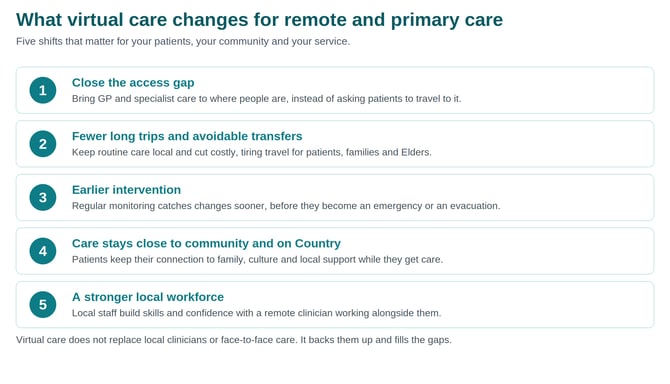
Close the access gap
Virtual care brings a GP or specialist to the patient through a secure video consultation, supported by clinical equipment at the patient end. A local team member runs the equipment while the remote clinician leads the consult. Patients get timely care without leaving their community.
Fewer long trips and avoidable transfers
Keeping routine care local cuts travel for patients, families and Elders. It also reduces avoidable transfers and evacuations, which are expensive for the system and exhausting for the person and their family. Early specialist input can prevent a problem escalating to the point where transfer is the only option.
Earlier intervention
Regular monitoring catches changes sooner. For someone managing diabetes, heart or kidney disease, a steady rhythm of check-ins and shared readings means problems are picked up early, while they are still manageable in the clinic.
Care stays close to community and on Country
For many patients, staying on Country and close to family is part of good care, not a nice-to-have. Virtual care lets people get clinical input without being separated from their community, their culture and their local support.
A stronger local workforce
This is one of the most important benefits, and the easiest to overlook. When a local nurse, Aboriginal Health Worker or Aboriginal and Torres Strait Islander Health Practitioner runs a consult alongside a remote clinician, they build skills and confidence. Over time that makes remote roles more rewarding and easier to keep, which helps with the workforce problem rather than working around it.
What to weigh up
Virtual care is a strong fit when distance, workforce gaps and travel burden are the main barriers to care. It works best as a supplement to face-to-face care, supported by reliable connectivity and a trained local team. It is not a replacement for a local clinician, and it depends on patient choice and consent.
The articles that follow show you how the model works, whether your service is ready, and how to plan a first rollout.
Need help?
- Visionflex support: visionflex.com/support | support@visionflex.com | +61 2 8914 4000 (9am to 5pm AEST)
- See also: How virtual care works; Is your service ready?; Your first steps: planning a rollout
Visionflex acknowledges the Traditional Custodians of Country throughout Australia and pays respect to Elders past, present and emerging.