
What this is: two structures that make virtual consultations safer and faster, ISBAR for handover, and A to G for systematic assessment.
Who it's for: registered nurses, enrolled nurses and clinical staff.
A remote clinician can't walk into the room and take in the situation at a glance. They depend on you to give them a clear, ordered picture. Two simple frameworks do that job. Used together, they turn a potentially scattered phone-style conversation into a focused clinical review.
ISBAR: handing over the situation
ISBAR is a structured handover. It makes sure nothing important gets missed and the clinician gets what they need in the right order. Prepare it before the call.
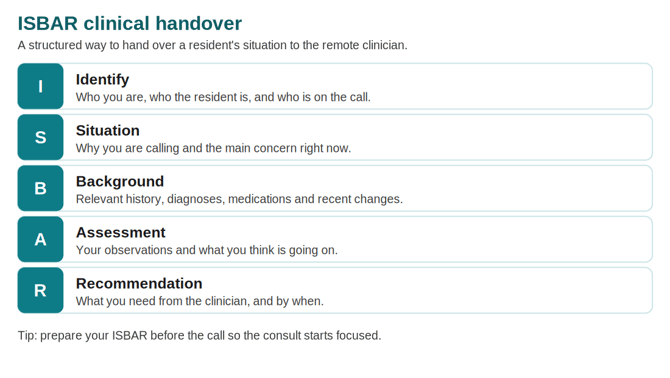
A worked example:
"Hi, I'm Sarah, the RN at Maple Lodge (Identify). I'm calling about Mr Allen in room 12, who has become short of breath in the last hour (Situation). He has COPD and heart failure, and was treated for a chest infection last month (Background). His oxygen saturation is 89%, he's working harder to breathe, and his chest sounds congested (Assessment). I'd like you to review him by video and advise whether we manage here or escalate (Recommendation)."
That's a complete clinical picture in under thirty seconds.
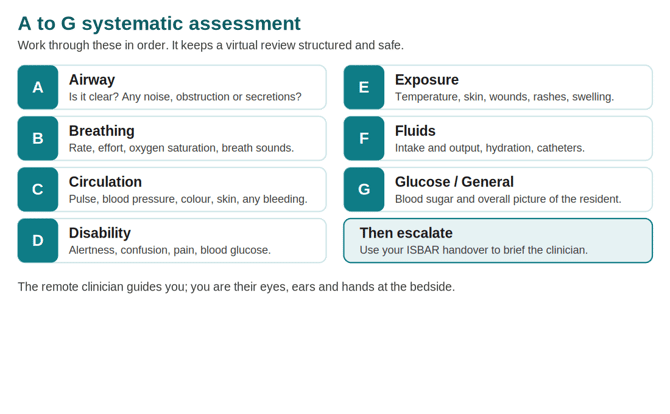
A to G: assessing the resident
Where ISBAR hands over, A to G structures the assessment itself. Work through it in order. It's the same systematic approach used across acute care, adapted for a virtual review where you are the clinician's hands at the bedside.
Putting them together
The two frameworks chain naturally:
- Use A to G to assess the resident and gather the clinical picture.
- Use ISBAR to hand that picture over to the remote clinician.
- During the consult, follow the clinician's directions to perform observations, use peripherals, and report what you find.
- Offer your own insights. You know this resident; the clinician doesn't. Your sense that something is "not right" is clinical information.
Why this matters for virtual care
Good structure is what makes a virtual consult as safe as an in-person one. It keeps the consultation focused, makes sure the clinician has what they need to make confident decisions, and gives you a clear role in the clinical conversation rather than just holding the camera.
Need help?
- Visionflex support: visionflex.com/support | support@visionflex.com | +61 2 8914 4000 (9am to 5pm AEST)
- See also: Before, during and after a virtual care consultation, and Virtual emergency and after-hours pathways.
This is general guidance, not clinical advice. Always work within your scope of practice and your home's policies.
Visionflex acknowledges the Traditional Custodians of Country throughout Australia and pays respect to Elders past, present and emerging.