
What this is: how virtual care supports ongoing chronic disease monitoring and care.
Who it's for: clinic and nurse managers, Aboriginal Health Workers and Practitioners, GPs and care coordinators.
Why this matters in remote and primary care
Chronic conditions, including diabetes, heart disease, kidney disease and chronic lung disease, sit behind much of the ill health in rural, remote and First Nations communities. They are also the conditions where steady, regular care makes the biggest difference. The problem is rarely knowing what to do. It is keeping the rhythm of care going when distance, workforce gaps and travel get in the way.
Virtual care helps by making that rhythm easier to keep, with the local team capturing readings and the remote clinician reviewing trends over time.
The monitoring loop
Good remote monitoring runs as a steady loop, not a one-off.
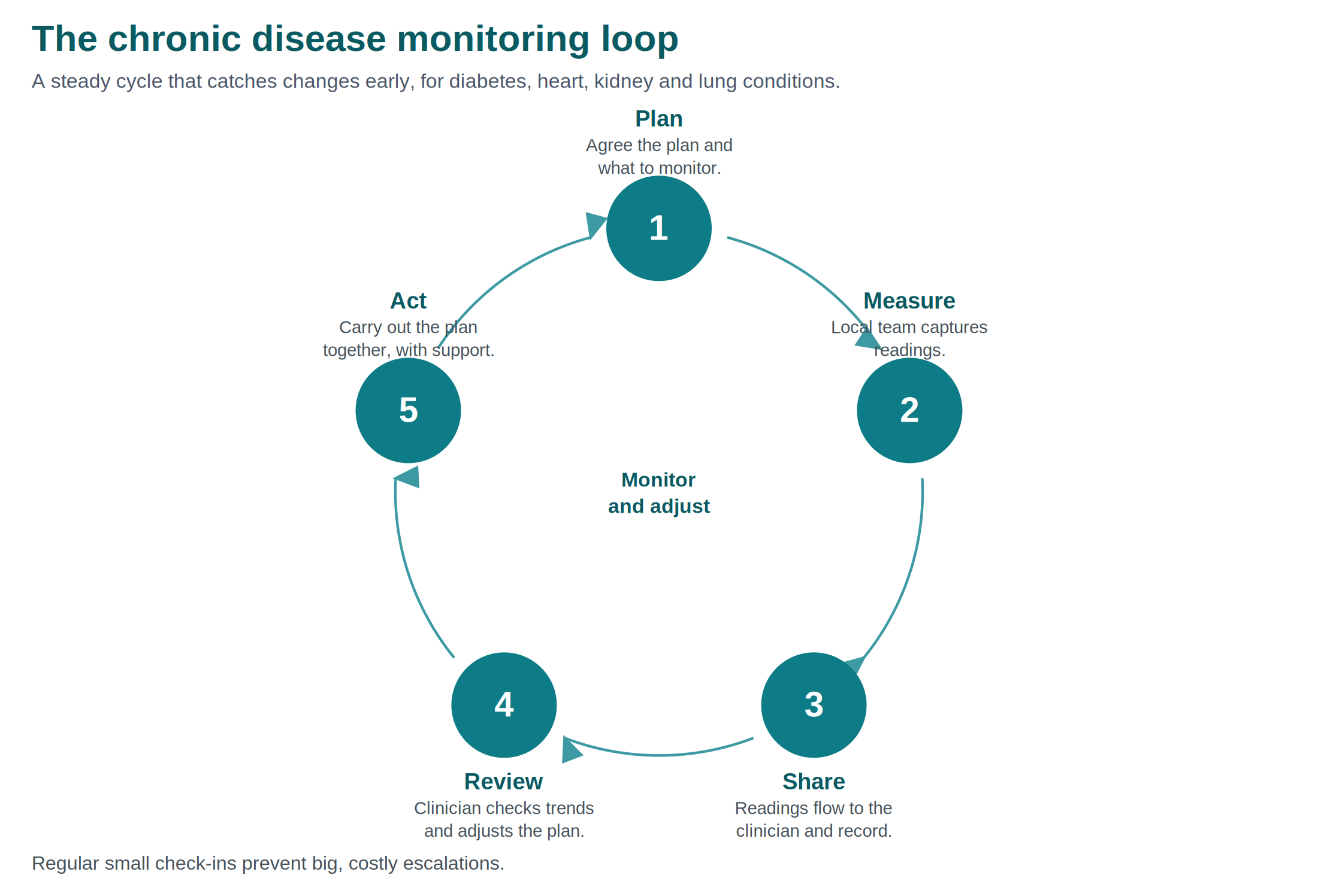
- Plan. The clinician and patient agree a care plan and what to monitor, for example blood pressure, blood glucose, weight or oxygen levels. A chronic condition management plan can set this out, and the local team can help prepare and review it.
- Measure. The local team captures the agreed readings using connected devices, on a set schedule the patient understands.
- Share. Readings flow to the remote clinician and into the patient's record, so trends build up over time rather than living on scraps of paper.
- Review. The clinician looks at the trend, not just a single number, and adjusts the plan if needed.
- Act. The patient and local team carry out the plan, with education and support, then the loop continues.
What good monitoring looks like
- The plan is realistic for the patient's life, not just clinically ideal.
- Readings are taken the same way each time, so trends are reliable.
- The patient understands what the readings mean and what to do if something changes.
- Someone owns the follow-up, so a worrying trend is acted on, not lost.
- The local team can escalate quickly if a reading is dangerous.
The local relationship drives it
Monitoring only works if the patient keeps showing up. In most communities, that comes down to trust. When the person taking the readings is someone the patient knows and trusts, often a local Aboriginal Health Worker or Practitioner, engagement is far stronger and people stay in care longer. The technology supports the relationship. It does not replace it.
Linking to funding
Chronic disease monitoring and care planning can attract Medicare items, and there are specific items for services provided by nurses and Aboriginal and Torres Strait Islander Health Practitioners on behalf of a GP. The rules and items change from time to time. See the Funding and billing section for current detail.
Need help?
- Visionflex support: visionflex.com/support | support@visionflex.com | +61 2 8914 4000 (9am to 5pm AEST)
- See also: Specialist and allied health access; The patient-end role; Funding and billing
Visionflex acknowledges the Traditional Custodians of Country throughout Australia and pays respect to Elders past, present and emerging.