
What this is: how to use virtual care to connect patients to specialists and allied health without long travel.
Who it's for: clinic and nurse managers, GPs, care coordinators, Aboriginal Health Workers and Practitioners.
The problem with travel for specialist care
For many remote patients, seeing a specialist means a long trip, time off Country, cost, and time away from family and work. Some people put it off, or do not go at all, and conditions get worse. Virtual care lets the patient stay local while a specialist or allied health professional joins by video, with the local team running the examination at the patient end.
This works well for planned, non-urgent care: cardiology, endocrinology, dermatology, mental health, and allied health such as physiotherapy, dietetics, podiatry and speech pathology.
The access pathway
A virtual specialist consult comes together in a clear sequence.
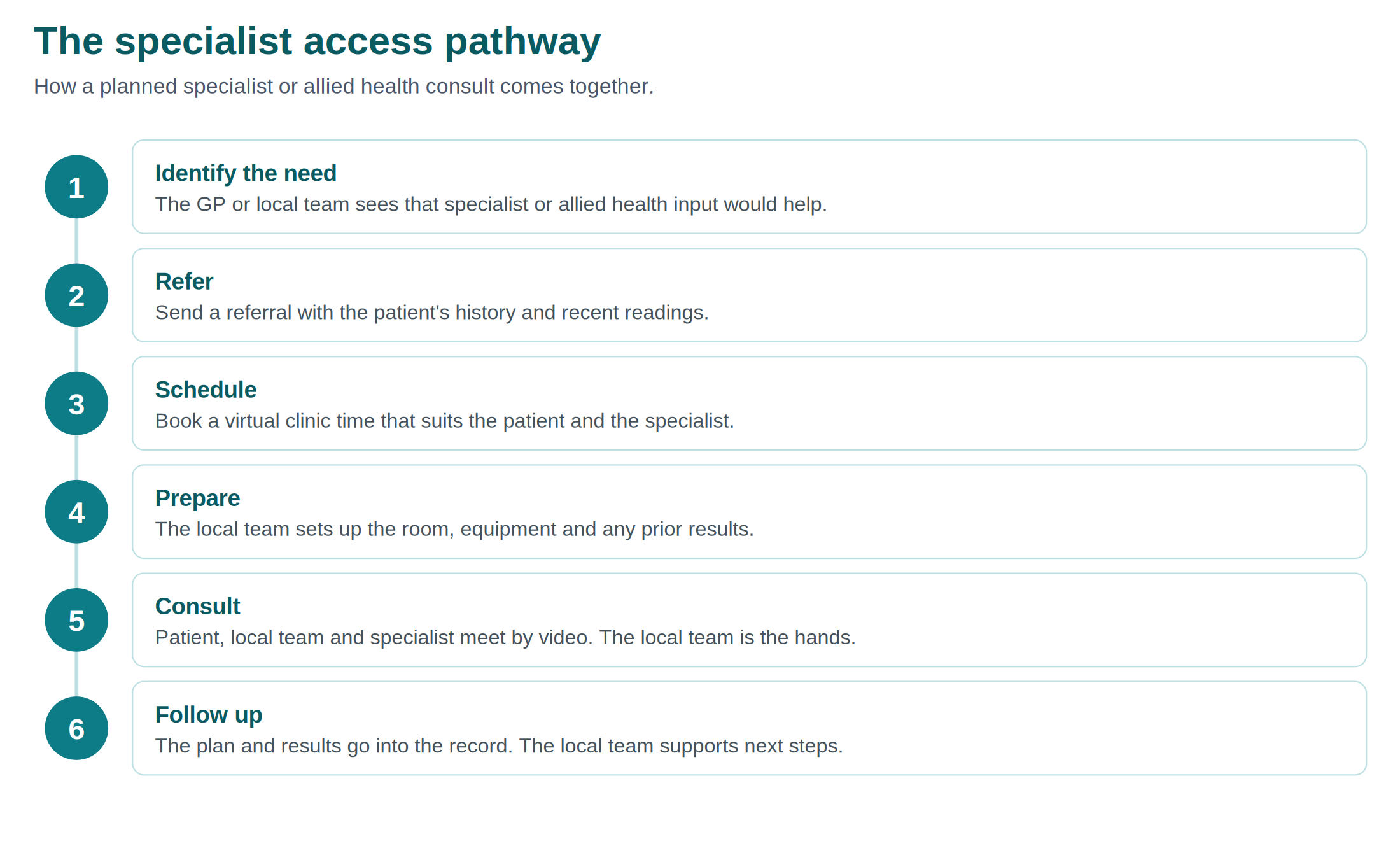
- Identify the need. The GP or local team sees that specialist or allied health input would help.
- Refer. Send a referral with the patient's history and recent readings, so the specialist arrives prepared.
- Schedule. Book a virtual clinic time that suits the patient and the specialist.
- Prepare. The local team sets up the room, the equipment and any prior results or images.
- Consult. The patient, the local team and the specialist meet by video. The local team is the hands, running the camera and devices as the specialist directs.
- Follow up. The plan and results go into the record, and the local team supports the next steps.
What makes it work
- Good preparation. A specialist who can see recent readings, images and history before the consult makes better use of the time.
- The right equipment for the specialty. Dermatology needs a good examination camera. A cardiology review may use a digital stethoscope and an ECG. Match the equipment to the consult.
- A capable patient-end team. The quality of the consult depends on the person in the room with the patient. Invest in their skills.
- A warm handover. The patient is more at ease when the local person they trust introduces the specialist and stays in the room.
Cultural safety in specialist consults
A visiting specialist may not know the community. The local team bridges that gap, by holding the cultural context, supporting communication, arranging an interpreter where needed, and making sure the patient is comfortable to speak up or ask the specialist to slow down. Build that role into the consult rather than leaving it to chance.
Need help?
- Visionflex support: visionflex.com/support | support@visionflex.com | +61 2 8914 4000 (9am to 5pm AEST)
- See also: Chronic disease monitoring and care; The patient-end role; Working with interpreters
Visionflex acknowledges the Traditional Custodians of Country throughout Australia and pays respect to Elders past, present and emerging.