
What this is: a plain explanation of how a virtual care consultation runs, and the main ways to staff it.
Who it's for: clinic and nurse managers, Aboriginal Health Workers and Practitioners, GPs, and anyone planning how consultations will work.
More than a video call
Basic telehealth is a phone or video call with no clinical equipment. It has its place, but it cannot replace an examination.
Clinically-augmented virtual care adds diagnostic equipment at the patient end. A local team member uses connected devices, a digital stethoscope, an examination camera, a video otoscope, an ECG and vital signs monitors, while the remote clinician sees the readings live and guides the consult. The result is much closer to an in-person examination, conducted from hundreds of kilometres away.
The hub-and-spoke model
The most common model in remote and primary care is hub-and-spoke. A central clinical hub of GPs, specialists and care coordinators supports local teams at remote, outreach and community sites.
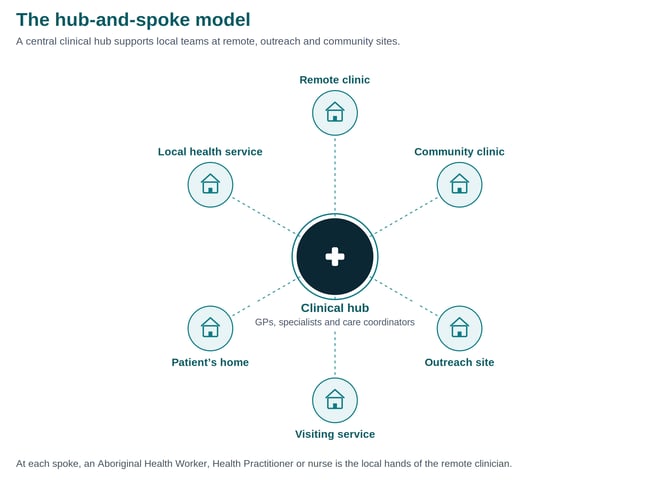
At each spoke, a local nurse, Aboriginal Health Worker or Aboriginal and Torres Strait Islander Health Practitioner is the local hands of the remote clinician. They prepare the patient, run the equipment, and provide the trusted, familiar presence in the room. The remote clinician leads the clinical decisions.
This model does two things at once. It gives the patient access to a clinician who is not physically there, and it builds the skills and standing of the local team. In community-controlled settings, the local team member is often the reason a patient feels safe to attend at all.
The two-room workflow
When a clinic has the space and the demand, the two-room workflow makes the most of scarce clinician time.
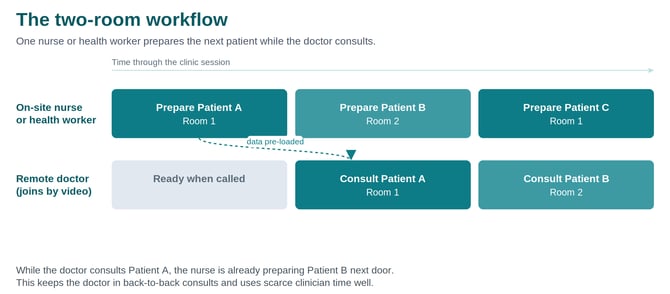
One nurse or health worker works across two rooms. They complete the full workup for the first patient, vital signs, examination images, heart and lung sounds, and load it into the record before the doctor joins. The remote doctor connects to a fully prepared patient and goes straight to assessment, with no time lost waiting for data. While the doctor consults in the first room, the nurse is already preparing the next patient next door. The doctor then moves straight across.
The effect is a steady, back-to-back rhythm that roughly doubles how many patients a clinician can see in a session, without rushing any single consult.
Unattended consults
In some communities there is no local clinical staff available at all. An unattended consult lets a remote medical officer run the whole encounter with no health worker at the patient end. The patient attends a fixed room, a secure kiosk or a portable kit, sometimes with a non-clinical support person, and the remote clinician controls the camera and the diagnostic devices directly.
This model has saved lives and avoided retrievals in very remote places. It also asks more of your governance. The remote clinician carries full clinical responsibility, consent and identity checks matter even more, and the model is generally less culturally safe than having a trusted local person in the room. Use it where there is genuinely no alternative, and prefer the assisted model with a local team member wherever you can.
Which model fits you
- Hub-and-spoke with a local team member suits most remote and community settings, and is usually the most culturally safe.
- The two-room workflow suits busier clinics that want to lift throughput and use clinician time well.
- Unattended consults suit sites with no available local clinical staff, with the right governance and consent in place.
Most services use a mix, matched to the site, the day and the patient.
Need help?
- Visionflex support: visionflex.com/support | support@visionflex.com | +61 2 8914 4000 (9am to 5pm AEST)
- See also: Why virtual care in remote and primary health; Is your service ready?; Your first steps: planning a rollout
Visionflex acknowledges the Traditional Custodians of Country throughout Australia and pays respect to Elders past, present and emerging.