
What this is: a set of editable procedure templates that turn your virtual care policy into day-to-day practice.
Who it's for: quality leads, clinical leads and facility managers.
How to use this pack. These are general templates to adapt, not finished procedures. Replace every
[square bracket], align them with your own policy and numbering, and approve them through your governance process before use. They pair with the Virtual care policy template in this section.
A policy says what your home does. Procedures say how. This pack gives you eight procedures that together cover a complete virtual care service, from deciding a resident is suitable, through running the consult, to handling privacy. They're written to sit under your virtual care policy and to be adapted to your home.
The procedure set at a glance
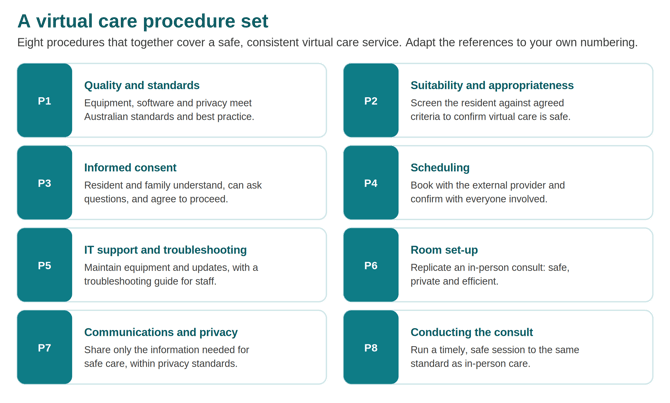
How the procedures fit together
The eight follow the natural order of a consultation. The first three set things up (standards, suitability, consent), the next three handle logistics (scheduling, IT support, room set-up), and the last two cover the consult itself (communications and privacy, conducting the session).
Procedure 1: Quality and standards
Purpose: make sure the equipment, software and privacy practices meet Australian standards and best practice.
Key requirements to adapt:
- The audio and video systems used meet Australian regulations and standards.
- Equipment, software and networks are installed and maintained to approved guidelines.
- The consultation is managed to the same clinical standards and model of care as an in-person visit.
Procedure 2: Suitability and clinical appropriateness
Purpose: screen each resident against agreed criteria to confirm virtual care is safe and appropriate for them.
Key requirements:
- Staff assess suitability considering clinical, cognitive, sensory and communication factors.
- Virtual care is not used where an in-person assessment or urgent transfer is clinically required.
- The decision and reasoning are recorded.
Procedure 3: Informed consent
Purpose: make sure the resident (and family where appropriate) understands virtual care, can ask questions, and agrees to proceed.
Key requirements:
- The resident is given the chance to discuss and ask questions about the consultation.
- Consent is obtained and recorded before the consult, using your consent form.
- Additional consent is obtained if any part may be recorded or images taken.
- Where a resident lacks capacity, an authorised decision-maker is involved.
Procedure 4: Scheduling
Purpose: schedule the consult in collaboration with the external provider and confirm with everyone involved.
Key requirements:
- Liaise with the external provider for a suitable time, matched to the clinical reason for the review.
- Confirm details with all participants once booked.
- Advise the resident and family, and remind them the day before.
- Confirm timing with the provider on the day, around an hour ahead.
Procedure 5: IT support, connection and troubleshooting
Purpose: keep equipment and connections working, with clear steps when something fails.
Key requirements:
- Equipment is maintained and updates applied, with a named responsibility.
- A troubleshooting guide is available to staff at the point of use.
- A failover pathway exists (audio-only or phone) if the connection won't hold.
Procedure 6: Room set-up and physical surroundings
Purpose: replicate an in-person consultation as closely as possible, for safe care, privacy and efficiency.
Key requirements:
- A private, quiet, well-lit space, with signage for shared rooms.
- The resident positioned comfortably and clearly visible.
- Equipment and peripherals tested before the resident is brought in.
Procedure 7: Communications and privacy
Purpose: make sure information shared between providers enables safe care, within privacy standards.
Key requirements:
- Share only the information necessary for the resident's care.
- Confirm who is present on both sides of the call.
- Handle images and device outputs as health information, stored and shared only via approved systems.
- Don't use personal messaging apps for clinical information.
Procedure 8: Conducting the consultation
Purpose: run a timely, convenient and safe session that meets the same standard as an in-person consult.
Key requirements:
- Give a structured clinical handover (ISBAR) and follow the clinician's directions.
- Keep the resident at the centre, and check their comfort and understanding.
- Document the outcome and any care plan changes.
- Complete follow-up actions and handover to the next shift.
Make them yours
These procedures are a starting point. Adapt the detail, the references and the responsibilities to your home, fold in your existing forms and systems, and have them approved through your usual process. Consistent procedures are what make virtual care safe and repeatable across teams and shifts.
Need help?
- Visionflex support: visionflex.com/support | support@visionflex.com | +61 2 8914 4000 (9am to 5pm AEST)
- See also: the Virtual care policy template, Updating your existing policies, and the Virtual care readiness audit.
This is a general template, not legal advice. Adapt and approve it through your own governance process.
Visionflex acknowledges the Traditional Custodians of Country throughout Australia and pays respect to Elders past, present and emerging.