
What this is: a practical workflow for managing wounds with a remote clinician, using the examination camera and your virtual care equipment.
Who it's for: registered nurses, enrolled nurses and clinical staff who support wound reviews.
Wound care is one of the highest-value uses of virtual care in aged care. Around 450,000 Australians live with chronic wounds, most of them older people. Wounds need regular, consistent review, and that's exactly what virtual care makes easier: a remote clinician can see the wound clearly, guide assessment, and track healing over time without the resident leaving their bed.
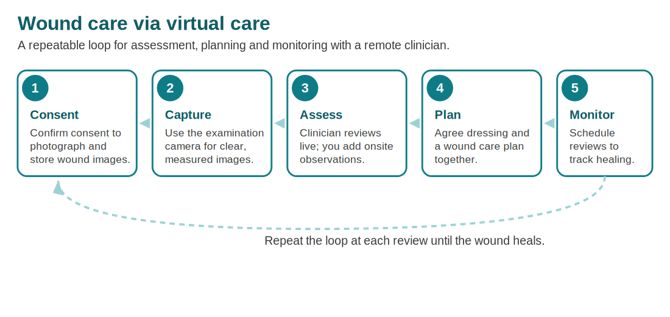
The wound care loop
Wound care works best as a repeatable loop. Each review follows the same five steps, so the resident gets consistent assessment and the clinician can compare progress accurately over time.
Before you start
- Confirm you're appropriately trained and competent to support wound management via virtual care.
- Confirm consent to take and store wound photos, and follow your home's policy on clinical images.
- Have the resident's records, current wound care plan and recent images ready.
- Consider asking a second staff member to assist, wound positioning and imaging are often easier with two people.
Capturing a good wound image
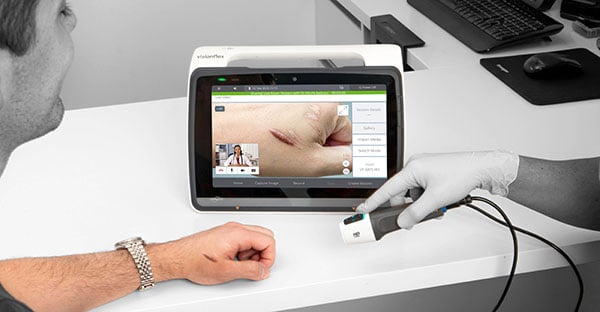
Image quality is everything in remote wound review. The examination camera (GEIS) captures the detail a clinician needs.
- Clean and prepare the site as directed before imaging.
- Use even, front-on lighting. Avoid shadows across the wound.
- Hold the camera steady and square to the wound, not at an angle.
- Include a measurement guide in frame if your home uses one, so size can be tracked.
- Capture the whole wound and a close-up of any area of concern.
During the review
- Give the clinician a clear handover (use ISBAR, see the handover guide in Clinical workflows).
- Follow the clinician's directions for assessment, site preparation, dressing and management.
- Add your own onsite observations: odour, exudate, pain, surrounding skin. These are things a camera can't show.
- Check the resident understands what's happening and is comfortable throughout.
Planning and monitoring
- Agree the dressing and wound care plan with the clinician before ending the consult.
- Record the plan and the images in the resident's clinical record.
- Schedule the next review so healing is tracked on a regular cadence.
- Adjust treatment only as directed by the clinician.
- Work with the wider care team where other factors (nutrition, mobility, diabetes) affect healing.
What good looks like
Homes using virtual care for wound review report earlier detection of deterioration, fewer avoidable transfers for simple visual checks, and more consistent measurement between staff. One Visionflex aged care site built regular wound monitoring into daily cart use, alongside virtual GP rounds and ED escalation, and saw wound review become a routine part of care rather than a reason to send a resident out.
Equipment you'll use
The examination camera does the clinical heavy lifting, supported by the wider Visionflex platform.
Need help?
Your Visionflex team is here to support your rollout, training and day-to-day use.
Visionflex support: visionflex.com/support | support@visionflex.com | +61 2 8914 4000 (9am to 5pm AEST)
See also: Before, during and after a virtual care consultation, and the ISBAR and A to G handover guide.
This is general guidance, not clinical advice. Always work within your scope of practice and your home's policies.
Visionflex acknowledges the Traditional Custodians of Country throughout Australia and pays respect to Elders past, present and emerging.