
What this is: a practical approach to training staff and managing the change, so virtual care sticks.
Who it's for: education leads, clinical leads, facility managers and virtual care champions.
Technology rarely fails on the hardware. It fails on adoption. A home that trains well and manages the change thoughtfully gets virtual care woven into everyday care. A home that doesn't ends up with an expensive cart gathering dust. This article covers both: how to train, and how to bring your team with you.
A blended training pathway
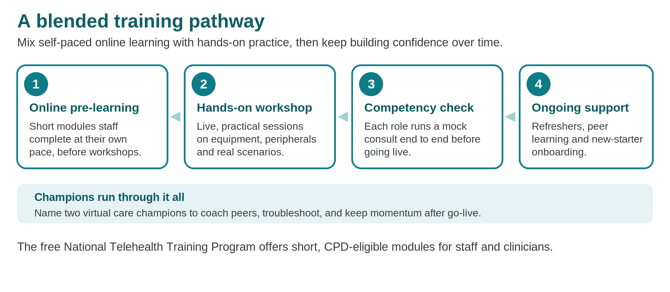
The most effective approach for busy aged care teams blends self-paced online learning with hands-on practice, then keeps building confidence over time.
Make it role-based
Training works best when it's practical and tailored to what each role actually does. Focus on running a session end to end, including consent, documentation and escalation.
| Role group | Training focus | Competency check |
|---|---|---|
| Registered / enrolled nurses | Setup, peripherals, consent, escalation, documentation | Run a mock consult end to end |
| Care staff | Resident preparation, privacy, assisting during a consult | Support a resident through a mock consult |
| Admin / coordinators | Booking, invitations, pre-read packs, follow-up | Schedule and send a test invite correctly |
| External clinicians | Joining calls, communication, documentation handover | Complete a short test call |
| Champions | Troubleshooting, coaching, issue logging | Troubleshoot common issues in a simulation |
Record attendance and completion, and provide refreshers for new staff and after quieter periods.
Free national training
The National Telehealth Training Program offers free, consistent training for anyone supporting virtual care in residential aged care, with separate streams for care staff and clinicians. The modules are short (around six minutes each) to fit around a shift, CPD points can be claimed, and they're endorsed by the RACGP, the Australian College of Nursing and ACRRM. Organisations can also load the modules into their own learning system. Visionflex provides hands-on training on your specific equipment to complement this.
Managing the change
Good training isn't enough on its own. People adopt new ways of working when they understand why, feel involved, and have support. A few things that consistently help:
- Name your champions. Identify two staff (ideally a clinical or education lead) to coach peers, troubleshoot and keep momentum. This is the single biggest predictor of whether virtual care embeds.
- Communicate the why. Explain the benefits for residents and for staff, and how virtual care aligns with quality standards. Address concerns openly.
- Involve staff early. Invite input on workflows and which use case to start with. Ownership beats mandate.
- Start with one use case. Pick a clear first use, often wound care or virtual GP rounds, and build from a win.
- Create feedback loops. Use toolbox meetings or a simple issues log to capture friction, fix it quickly, and tell staff what changed.
- Celebrate early wins. Recognise early adopters and share their stories. Confidence spreads.
Keep it going after go-live
Adoption is won in the weeks after launch so plan a period of close support with daily check-ins in week one, then a lighter touch through the first month and a clear point of contact for issues. Review usage regularly, and onboard new staff and new providers as you go. The goal is for virtual care to stop feeling new and start feeling normal.
Need help?
- Visionflex support: visionflex.com/support | support@visionflex.com | +61 2 8914 4000 (9am to 5pm AEST)
- See also: the Virtual care readiness audit and What good looks like: case studies.
Visionflex acknowledges the Traditional Custodians of Country throughout Australia and pays respect to Elders past, present and emerging.